Showing posts with label chile. Show all posts

Monday, July 04, 2022

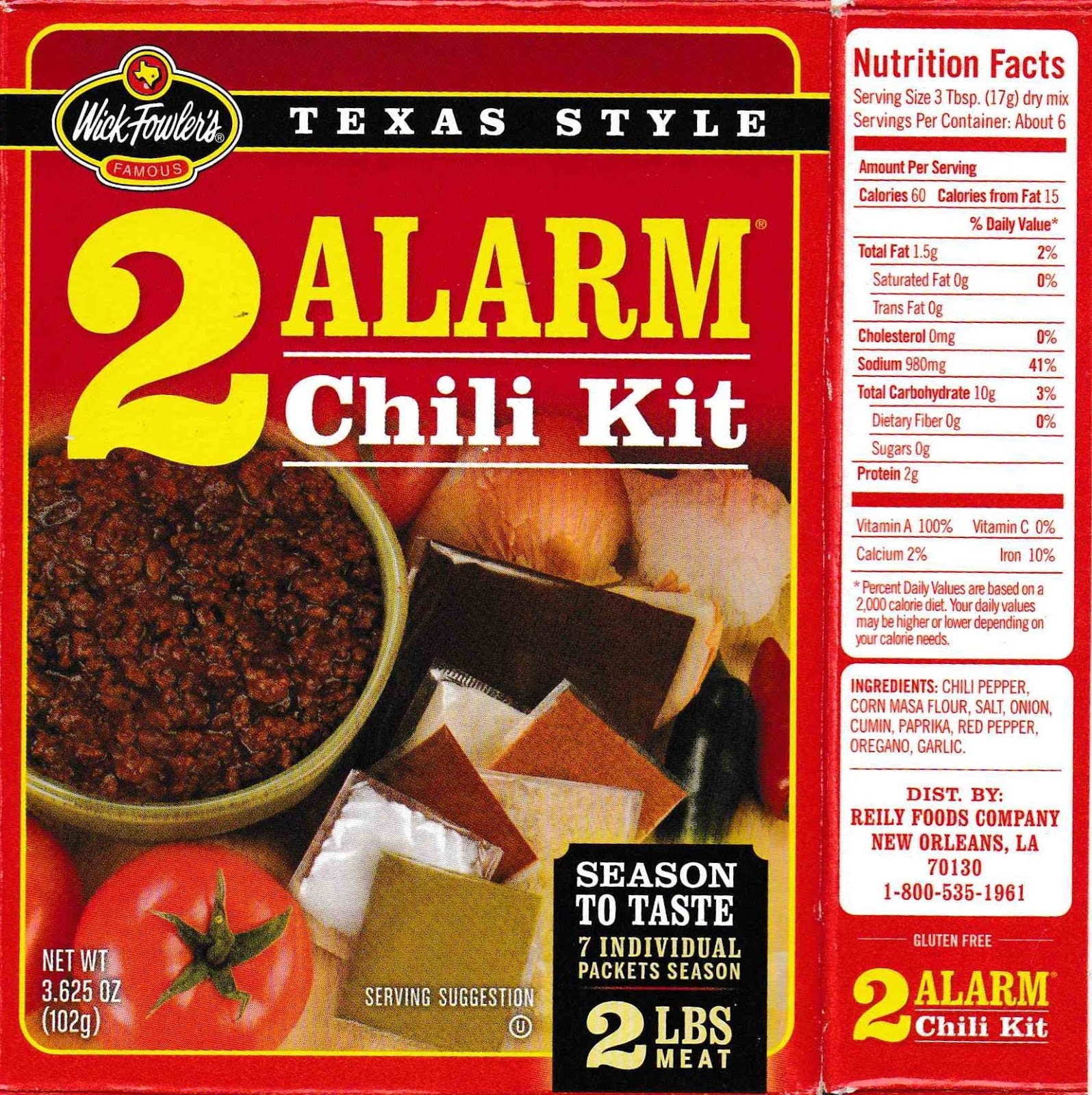
Wick Fowler's Famous Texas Style 2 Alarm Chili Kit


For two decades I've made Wick Fowler's Famous 2 Alarm Chili. I'm not sticking to that spelling: chili. By all rights it should be: chile. Due to differences in whether chile is or is not made with beans, I will not be going into details of my finished product. Or why I spell as I do.

I'm here to talk about those ingredients. As I said for 2 decades . . . and then the maker, Reilly Foods removed the salt from the package. And idiot that I was (or am), made a batch of chile and forgot the salt. I know that everyone has rising costs. As I type this in July of 2022, gasoline is over $6 a gallon, up from less a gallon only a short time ago. So I forgive Reilly Foods for removing the salt packet. But I'm unhappy that they did this and I would have paid more for the original recipe box. (I'm also the guy who wants to hear the sounds of the baseball game, but not the sportscasters.)

Some while ago, I got out my small electronic scale that can resolve to .1 grams. I weighed each of the Fowler spices packets in their bags, as the weight of those bags isn't much. And I did weigh the empty packets and it is an insignificant amount by comparison with the ingredient inside it.

I went to my nearest Hispanic market. They carry a large wall of spices. There I purchased, all Chulada brand of spices.

Ingredient List

96 grams Chile Pasilla Molido -- This is finely powdered chile pasilla (dark brown)
9 grams onion powder
9 grams garlic powder
6 grams cumin powder
7 grams oregano (I have flakes or dried leaves)
10 grams salt
7 grams paprika
6 grams Chile Arbol (labeled Red Pepper on the packet)

The above list is a your-mileage-may-vary scenario. Please don't leave snarky comments about how this doesn't taste like 2 Alarm. I would agree it does not. But it gets pretty close and the above list is what I used. As the recipe requires 96 grams of pasilla, you will have leftover spice mixture. My first attempt at this is in July of 2022, so it's a work in progress

Before I go any further, you will not be saving money making your own "kit". Fowler's is about $3.50 per box and I bought all fresh spices and that came to pennies under $7. But if you have read this far, perhaps you are foodie enough to try it yourself.

I did not weigh the packet of masa corn meal. I don't generally use it. I apologize. By law, ingredients listed on packages of food sold in the USA, must be by weight. From the 2 Alarm box:

Chile pepper
Corn Masa Flour (my guess is 2 ozs.)
Salt
Onion
Cumin,
Paprika
Red Pepper
Oregano
Garlic

If you read my list of ingredients and compare with the list above, it is inconsistent. I can only suggest you play around with the quantities. Who doesn't love making chile anyway?

The cumin and oregano are both in one packet in Fowler's. I guesstimate that it is equal parts of each. I can say that I like the flavor of this mixture I made. It's spicy enough to my taste. However, I used no Red Pepper (I believe this is Cayenne pepper or chile, as it is the most abundant commercially and therefore the least expensive to use.)

I weighed all the ingredients into a 2 cup jar; tightened the lid and gave it all a good shake. It stood on the kitchen counter for a few hours before being used. The aromas melded nicely together.

My one serious problem with Fowler's is that their packaging line has started to make improperly sealed packets. I see some onion flakes on the cardboard box I've retained. One box the onion/garlic packet was almost empty and the contents in the cardboard box itself. 

Lastly, next batch I'm going to use a mild New Mexico red powder or a California powder. It's got to have some chile taste, so I won't use paprika.

I made the standard Fowler's recipe. 2 lbs. of ground beef, 8 oz can of tomato sauce, 2 cups of water. The beef was browned and drained of excess fat. I added the tomato sauce and water and then the spices. Covered the skillet simmered for 30 minutes. The batch threw a good amount of liquid, which colored beautifully.

It's important to understand that the ingredients that Reilly Foods buys to make the 2 Alarm Chili is based on science and I cannot buy, at a market, the same ingredients with the same specific gravity or weigh by volume. My recipe is an approximation. Their onion flakes or garlic powder have food properties I cannot replicate (as much as I wish I could). The onion powder I have is not going to be the literally same thing as Fowler's. But I believe I have a good start and am narrowing the focus until that day of heavenly chile perfection arriving.

If you ever read: A Bowl of Red by Francis X. Tolbert, you will learn that in Texas, the spices are toasted to bring out their individual flavors. Whether Reilly Foods does that I cannot determine. I tried toasting cumin seeds for a batch of chile one time. I think I cooked the flavor out. And oregano leaves are almost impossible to toast without burning them.

Serious comments appreciated.

January 20, 2023. The price of Fowler's mix has gone up a bit. I tried another idea. I used All California Chiles with the seeds. It took two (or more) minutes in the blender getting the pods into powder. I should have removed the seeds. The first eating the dish was sort-of gritty. Not good. The next day, the grit was entirely gone. I think it is the seeds not being ground well enough. The all California chiles proved to be too mild, too. Next batch, I'm going to mix half California and half Pasilla. The flavor was good on the 2nd and succeeding days. Man! oh Man! I do love a bowl of red.

Monday, January 18, 2021

Reproduction Chile Sauce with the Secret Ingredient

I've researched condiment recipes as much as I can. These types of recipes are closely guarded secrets. Think Coca-Cola. They don't want a copy of that getting out.

I've always wanted to make my own chile sauce. Pardon the other writer's misspelling, as it should not be chili.

Some while ago, I had found a cookbook author, one Gisine Lemcke, who ran a cooking school in Brooklyn NY in the late 19th early 20th century.

Below is her recipe. It's use of green tomatoes will impart that slight tang that chile sauce has, and that ketchup does not have. Heinz Chili Sauce sells at a premium to Heinz Ketchup. Now you know why.

Preserving and Pickling
By Gesine Lemcke
New York: Appleton, 1919

https://www.google.com/books/edition/Preserving_and_Pickling/08pDAQAAMAAJ?hl=en&gbpv=1

Chili Sauce No 1

24 ripe tomatoes
15 green tomatoes
4 large onions
3 green peppers
4 tablespoonfuls of salt
2 tablespoonfuls sugar
1 quart of vinegar
1-2 tsp. cloves
1-2 tsp. allspice
1-2 tsp. ginger
1-2 tsp. cinnamon

Scald and free the ripe tomatoes from their skin and cut them in small pieces. Cut also the green tomatoes, the peeled onions and the green peppers, put all the ingredients in a kettle boil slowly 1 2 hours. 

Mrs. Lemcke, does not describe more than the above. Maybe this will cook to the correct consistency and not need a milling, but keep that in mind. Some bits are acceptable. I imagine Heinz removes the seeds from theirs as that would impart a bitter note.

If preserving with sodium benzoate, remember not more than .1%, that is .001 by weight. Add the benzoate after cooking, but before the pot reaches room temperature.


Saturday, November 17, 2018

Lao Gan Ma Noodles And It's Celebrated Sauce


There are a number of jarred sauces from China which seems to have the notion of family or relatives involved with the name or on the label. One such is, in Chinese:


Guiyang Nanming Laoganma Flavor Food Co., Ltd. was started by a woman named Tao Huabi 陶华碧 and has a fascinating history. She keeps her company unlisted, does not borrow from banks to expand her company and is named in Forbes Magazine as one of wealthiest Chinese. The company names roughly translates into English as The Old Godmother.

The products page. All in Chinese. Untranslated. (And somewhat untranslatable unless you are fluent in both Chinese and cookery.)

As the sauce obtains pride of place in this dish, I giving a double quantity. Sauce your noodles well, and serve the extra for diners who like more of it.

I prefer egg noodles for this dish, but classically it's served on rice noodles.

Protein:

1 pound of flank steak or pork loin, cut into matchsticks
1 tbs of garlic paste
2 tsp of ginger paste
1 tsp light soy

Carbohydrates:

16 oz noodles, chopped into bite size lengths. I cut the package into sixths.
1/2 to 3/4 cup of raw peanuts
1 package of pickled Sichuan vegetable (rinsed in water and chopped a little)
2 (or more) gai lan, coarsely chopped (Chinese broccoli)

Sauce:

4 tsp light soy
2 tsp dark soy
1-2 tsp black vinegar
2 tsp sesame oil (Kadoya brand recommended)
2-4 tbs scallions, cut in 1/8 inch slices
2 tsp ginger paste
1 tbs garlic paste
2 tsp white sesame seeds toasted
3 tbs Old Godmother Sauce (or any brand of chile bean sauce or "paste")
5 tbs peanut oil
1 cup cilantro, chopped with stems

Heat a dry skillet and toast the sesame seeds until they darken in color. Remove and reserve to cool. Slice the meat into matchsticks. Neatness doesn't count here too much. If you have a box grater or Microplane, reduce the garlic and ginger to a paste. (I prefer the term mush.) Mix the pastes into the meat and add 1 tsp of light soy, reserve.

Mix the soy sauces, vinegar, sesame oil, preserved vegetable, garlic, ginger, godmother, sesame seeds and scallions in a metal container. Reserve. Metal because hot wok cooking oil will be added shortly.

Heat a 2 quart or larger pot with water to cook the noodles. Add no salt. Use enough water to almost cover all the noodles. Put on high heat, uncovered. When the noodles start to simmer, remove from the heat and drain the noodles in a colander. Reserve.

Heat the wok, add the oil. On low heat, fry the peanuts for 5 to 7 minutes. Remove from the wok and add to the sauce.

Put the heat up to high on the wok. Add more peanut oil, at least 3 tbs. When starting to smoke, add the marinated meat in batches so as to not cool the wok too much. Stir fry and brown some of the meat, when browned remove to a bowl and stir fry the remaining meat. Use the Chinese spade (spatula) tool to remove the browned meat, allowing the oil to drain back to the bottom of the wok.

When all the meat is cooked, pour half of the hot oil into the reserved sauce. It will sizzle for a few seconds. Put the wok back on the heat, and while it is reheating, stir the oil into the sauce using a teaspoon or long handled spoon.

Add the noodles to the wok and stir fry them a few minutes. If some of the noodles brown a little that's excellent. Add the gai lan. Add 2 tbs of water to the wok, stir the noodles and gai lan. Cover for 2 to 3 minutes to steam the gai lan. Remove the wok, add the meat, stir to mix well. Add the sauce and stir again. Recover the wok, put on lowest heat. Wait 5 minutes. Serve with chopped cilanto. Have extra light soy, sesame oil and Sriracha sauce available for diners to help themselves.

Cook's Note: some sauces call themselves sauce others call themselves paste. They all work exactly alike.

Tuesday, December 27, 2016

Run Don't Walk

Your Author, ever on the hunt for only the most authentic ingredients, while sojourning in the darkest part of Los Angeles, spied a new wholesale spice shop specializing in chiles (mistranslated and thus misspelled chili) from across the globe.

I post this pix of the exotic Peruvian ají amarillo.


Yellow as the Sun
I paid but $6 for a whole pound. 


1244 E. 8th Street
Los Angeles, CA 90021
213-623-3430
Praxedes Hernandez, Prop.

This is the Los Angeles wholesale produce district.

Pollo a la Brasa, here we come!

Tuesday, January 06, 2015

Kung Pao Chicken or Shrimp - 四川人宫保鸡丁


The Chinese ideographs above are: Sichuanese Kung Pao Chicken.

In Pinyin that is: Sìchuān rén gōng bǎo jī dīng.

For me, Kung Pao Chicken will always be one of the first Chinese dishes I ever ate at a restaurant as an adult, that I remember. As such, my understanding of Kung Pao is based on that, and that alone, until now. I have devoted dozens of hours towards a better recipe. Both what I cook and where I eat it at Chinese take-out joints. See the links below about the chiles. For me, Kung Pao Chicken will always be a Chinese take-out item. You can eat it at the restaurant if you prefer, but it's part of what Chinese-in-America have for take-out or standard restaurant fare.

Although Fuchsia Dunlop has given English readers an authentic look into Kung Pao, I may have come across a little known technique, that is likely to prove to be the making of this dish in as an authentic Chinese Restaurant Take Out style as possible. (If you regularly read Danger! Men Cooking you know I don't often brag.)

Ms. Dunlop's interpretation of Kung Pao chicken is lacking in this respect. The chicken (or other meat/fish) must be velveted. I have seen multiple recipes that use whipped (or beaten) egg white to help marinate the chicken bits (cubes), in an attempt to velvet it. That's not it. It was not until today that I read about velveting meats that I realized that I have yet to have my own, homemade, Kung Pao Chicken dish. And I love to make authentic recipes. And Kung Pao Chicken is one of my favorites.

I have already located the Heaven Facing Chiles as the Chinese call them, and posted about them here. These seem to me to be the authentic ingredient for Kung Pao Chicken. Comments from Sichuan, greatly appreciated. I prefer these chiles (also spelled: chilis, chilies, chillis, chilles) because the have a fruity note and the heat dissipates from the tongue quickly . . . somewhat quicker than chile de arbol or japonese. Those being chiles often found in Kung Pao Chix.

So, Dear Reader, here is what I believe is the final piece of the puzzle as to how to make authentic Kung Pao Chicken (or Shrimp). You must use the oil blanching technique. Let me explain why. A busy Chinese restaurant will have as much food prepared ahead of time as possible. Then, when the rush for lunch or dinner comes, (even breakfast), the food or plates can be got to the diner as quickly as possible. This technique works for more than that reason alone, however. By oil blanching the meat, it has had the micro-organisms on the surface destroyed. It's safer. Now in a home cooking setting that doesn't matter so much, but in a restaurant, it is crucial. So not only does the food stay fresher, the oil penetrates the surface of the chicken or shrimp and flavor it. And by being browned, later, the food stays moister. The Chinese save this oil and at least one other cookbook calls it: cooked oil. Yes, I'm well aware that some say that once an oil is heated it shouldn't be reused. (Is that group the people selling vegetable oil?) I disagree. I have oil that has been used multiple times, and gets a little more flavorful each time it is used. The USDA's Food Safety Inspection Service, has a .pdf about reusing oil: hereThe oil I use is not used for deep frying, however, I use it for stir frying and sometimes for sautéing eggs or small foods. Yum. 

Here is how to oil blanch the cubed chicken or shrimps.

Batterie de Cuisine

Wok
Wok shovel or spatula (chuan)
Sieve - large enough to hold the quantity of food being cooked at one time
Metal or heat-proof (in the USA "Pyrex") bowls, or measuring cups
Paper toweling

Method:

Cube the chicken. Reserve. If you are using shrimp, cut them into bite-size morsels, if they are large. (Why would you use large shrimp in this dish and then cut them to size?)

In the wok, heat 8 ozs. of peanut oil. (I prefer peanut oil, use the oil you choose).  When it has reached 350° to 375° F, add the cubes in one batch. Stir to separate the cubes. Allow 1 minute for the chicken to blanch. Remove the blanched chicken to a sieve over a bowl and allow the oil to drain. After the oil has drained, transfer the chicken to paper toweling on a baking sheet. When the oil is drained onto the toweling, proceed with your way of making Kung Pao Chicken.

The chicken cubes will turn white within the prescribed minute. Do not brown them at this time.

What I like about this is that you can now make the vinegar sauce, mince the scallions or garnish, etc. Or you can do the other prep work first and them finish. It works well either way.

Copyright Mark Preston, the Secret Ingredient, Danger! Men Cooking, 2015.

Tuesday, December 03, 2013

Fowler's 2 Alarm Chili and Chile con Carne in general (part 1 of ∞ parts)


While shopping at the former closeout discounter: Pic 'n Sav (now Big Lots), there was in the food section several "chili fixins". This, dear reader, is the ONLY time I will use that abomination of the misspelling of chile. The entirety of Latin American and Spain use: chile. 'Nuff said.

The two fixins' were Wick Fowler's 2 Alarm and Carroll Shelby's. The International Chili Society got it's start with Fowler winning and Shelby crying "foul". But never mind the philosophy. We are here to cook. We are here to reproduce greatness.

I must doff my chef's toque to Francis X. Tolbert. 

 Tolbert, author of A Bowl of Red  is a must read for any serious cooker of chile. For there is the true secret ingredient to all chile con carne. That is freshly toasted chiles and spices. The flavor you savor may have the variety of commonly known additions, such as tomato, beans, cheese, raw chopped onion, mustard?, and whatever else the law will allow. Without freshly prepared spices, you come in second place. Don't get me wrong, I buy Fowler's 2 Alarm Kit. It's an easy meal for company. Brown the ground beef, add the tomato sauce, water and spices, simmer 30 minutes. Serve. Fast company food.

Having had both Fowler's and Shelby's Kit to mess with and having another gentleman to dine, it was debated and decided that Fowler's has the better flavor. Upon serious consideration of the matter the separate spice packages in Fowler's are a "fresher" flavor than the melange that is Shelby's. And I would like to point out that this is based on logical, objective and scientific reasoning, although you are no longer free to disagree with me, having read thus far.

So here begins an assay and essay into Fowler and his Fixings.

Upon opening a box of 2 Alarm, one is shown 7 (seven) packets of spices.

Chile Powder              48   grams
Onion/Garlic              9.3  grams
Cumin/Oregano        6.1  grams
Paprika                        3.4  grams
Salt                               8.6  grams
Masa                            12    grams
Cayenne                        3    grams

Total Weight             90.4 grams

The package must, by law, list the ingredients, by order of weight. Here is that list (October 2016). Chili Pepper, Corn Masa Flour, Salt, Onion, Cumin, Paprika, Red Pepper, Oregano, Garlic. As you can see, the package contradicts the above list. I'll remind you that recipes are chemical theorems. Experimentation is necessary for success. [This paragraph added October 2016].

That is about 3 ounces of spices for 32 ounces of ground beef (drained of fat). It is at this point in our learned Chile Cookery Assay/Essay that I must add a short detour about the current manufacturer of Fowler's Kits. Based in Louisiana (not in Texas) the product is from Reily Food Company. And further punctuating this history is a brief paragraph about the product from . . . "Arban"


guajillo?
What is of note here is the Arban says the recipe changed. I have only known Fowler's Kit fixings without the guajillo chiles in it. Having said that, I have obtained fresh (dried) chiles for my theory of what fixins' should be.

"Why?" you ask would you do this when you can buy Fowler's fixins'. Answer: when I started this weblog, I set out that the theme would be a look at the food competitor. The humorously competitive braggart whose "chile is better'n yurs".

The next assay/essay is to how much of the two blended packets there are in each.

Cumin/Oregano - from the aroma, there is more cumin than oregano

Onion/Garlic - from the aroma, more garlic than onion.

And what of the ingredient labeled: "chili powder". While that ingredient could occupy an essay in itself, I will aver that the basic ingredients are:

mild chile to be toasted and ground fresh (such as a blend of ancho and guajillo
oregano
garlic
salt
black pepper

and here is an approximation of Fowler's ingredients and I have converted the tbs/tsp into approximate grams to make a comparison with what came from the box of Fowler's, above

3 tablespoons chile powder  (45 grams)
1 teaspoon oregano (3 grams)
1 teaspoon cumin seed (3 grams)
2 onions, chopped 
6 or more cloves garlic, chopped (12 grams)
1 teaspoon salt (5 grams)
1 teaspoon cayenne (3 grams)
1 tablespoon paprika (3 grams)

The full recipe can be seen, here. Scroll down to Fowler's recipe, please.

As chile con carne must be something of an individual taste, and as I have met people (human beings) that cannot abide the flavor of garlic, all I can say is that I have pointed you in the right, true path and the rest is up to you.

Pictured below are the ancho and guajillo chiles. I have done my best to render the color accurately. Even though these chiles are dried, they are fresh, or maybe I should say (ironically) freshly dried. The color of each is distinct with the anchos being black to dark maroon, while the guajillos are dark brown to a slightly lighter maroon color than the anchos


Guajillo and Ancho or Pasilla


Monday, December 02, 2013

Peppadew Mustard with Malt Vinegar

At the risk of seeming cheap, I save the brine my Peppadew chiles come packaged in.

I had wanted to make some mustard with this brine for some time and yesterday, with Thanksgiving (US Holiday) far behind, I strained the brine and started adding mustard flour.

From the GS Dunn webpage:

Mustard Flour
Mustard flour is achieved by successive grinding and sifting to remove the bran of the mustard seed and produce a fine powder comprising the heart (kernel) of the seed. Mustard flours are used primarily to give mustard flavour to a product and for their functionality as emulsifiers. We have a wide range of flour blends of differing heat and flavour, and we produce many custom blends. 

Ground Mustard
Ground mustard is the whole seed ground as a powder (bran and kernel). Our range includes ground yellow, brown and oriental seed plus blends of yellow and oriental. Ground mustard is used as a vegetable protein in meat products, and to produce mustard sauces. 

Crushed Mustard Seed
Crushed mustard seeds are exactly that – mustard seeds which have had the outer layer cracked open to expose the flour inside. They are primarily used for appearance and texture in country-style mustards and salad dressings. Yellow, oriental and brown mustard seeds can be crushed, but by far the most popular is the brown which has a good contrast between the yellow interior and the brown exterior of the seed. 

Mustard Bran
Mustard Bran is the outer husk of the seed which has been removed during flour production. It is shipped in its raw state, coarse flakes, or it is ground to a fine powder. Yellow bran is highly functional having the ability to hold up to 9 times its weight in water, and is widely used as a natural thickener in sauces. 

Deactivated Yellow Mustard

World-wide trends toward a healthier lifestyle prompted us to develop a unique process of enzyme deactivation in a natural, non-chemical environment. Deactivated mustard retains the functional properties of mustard and is used as an emulsifier and protein source in various food applications such as meat products, dressings, mayonnaise, sauces, tomato based products, batters and baked goods. 

I added some of the Mustard Flour I had and started adding it to the chile brine. Then I added some malt vinegar, salt, a 1/2 tsp. of sugar and 1-2 tbs. each of yellow and black mustard seeds. Then I added some more mustard flour. When the heated liquid contact the mustard they thicken pretty quick. I stopped as soon as I could as I like spicy mustard. I left the pot on the porch to cool overnight and bottled the next day.

I know this isn't a recipe with quantities, but it's better if you adjust the flavors and thickness to your own liking.


Saturday, June 16, 2012

Peppadew - A Chile From South Africa

I prefer not to post about products, as I have said, before, but occasionally I make an exception. This is one. The food importer FoodMatch.com has started importing Peppadew "peppers" from South Africa. Technically these are chiles, but Thank You, Christopher Columbus for mixing up India with America.

Anyway: here is an easy way to get them where you are.


My local market sells the Peppadew in a brine. It is salty-sweet-hot, and I like to chop some up for sandwiches.